


Halovo Hands Thumb Stabiliser
Halovo Hands Thumb Stabiliser
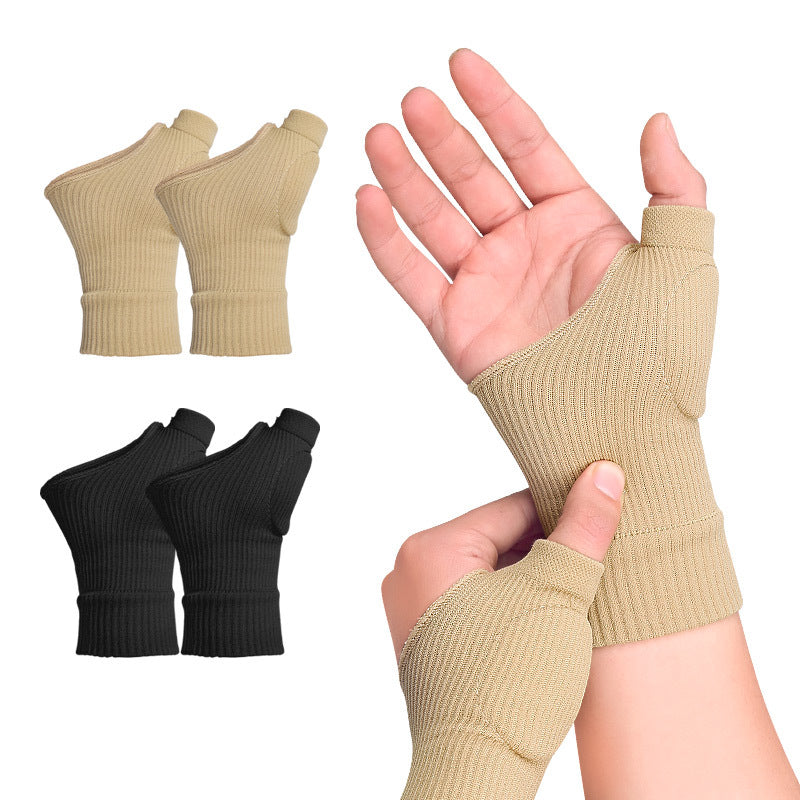
A thumb stabiliser that cushions the joint at the base of your thumb while you work, and leaves your fingers and fingertips completely free.
What’s included, and how to size it
Sold as a pair. Left and right, in the same size.
- All four fingers and your fingertips stay bare
- Soft ribbed cuff over the wrist, no straps and nothing rigid
- Two sizes, so measure your hand before ordering
- Beige or black
- 60 days to try them
Couldn't load pickup availability
Halovo Hands Thumb Stabiliser
Get it between - and -.


For guitar players
The hand that frets is the hand that pays for it.
The joint that goes is the one at the base of your thumb, the one pressed against the back of the neck. Barre chords load it hardest, and a song built on power chords keeps it loaded for minutes at a time.
Reading through what players actually say about this, two things came up over and over. Sessions end earlier than they should. And the supports that help at rest are the ones you cannot play in.
This is a soft knit sleeve, not a brace. The padding sits low over the base of the thumb, clear of the back of the neck, and all four fingers and your fingertips stay completely bare, so the strings feel the way they always did.
We have played barre chords in them for about twenty minutes with the padding staying out of the way. That is our own test rather than a promise about your hands, and it is not a claim that the sleeve reduces pain. If your thumb needs rest, or your guitar needs a setup, it still needs those.

You are not trying to stop hurting. You are trying to keep playing.
We read five threads of players talking about this joint. In 22 of 28 accounts the goal was never comfort on its own. It was the next song, the chord they had given up, the guitar they wanted back out of the case.

First the chords go.
Barre chords tend to be the first to get dropped, then the songs built on power chords. They are the shapes that keep the base of the thumb loaded the longest, so they are the ones quietly written off.
Then the sessions get shorter.
Not a decision, just an ending. The point in the evening where the ache stops being background noise and starts deciding when the guitar goes down.
Then the case stays shut.
In the threads we read, more than one player described instruments sitting cased for good. Nobody set out for that. It is just where the other two steps lead.
Rest works until you play again.
A week off settles it down. The first hour back undoes the week. That is the part that makes people give up on fixing it at all.
Which is why the fix has to be something you can wear while you play, rather than something you take off to pick the guitar up. A support that only helps once you have stopped has not given you anything back.
If this sounds familiar
You already know the twenty minute mark.
The point in the evening where the ache at the base of your thumb stops being background noise and starts deciding when you put the guitar down. Or the needles, or the toddler who wants picking up again.
Resting helps, and then it does not. Put the work down for a week and it settles. Pick it back up and it is back inside the hour.
The braces you tried held the wrong part. A wrist brace holds the wrist, and the thumb carries on moving. Compression gloves cover the fingers, which is exactly where you need to feel what you are doing.
There is a mechanical reason it keeps happening.
Why it keeps coming back
Your thumb joint shifts about a thousand times an hour while you work.
At the base of your thumb there is a small saddle joint. It is what lets your thumb swivel and pinch, and it is the joint doing the work every time you pinch a pick, a needle, a pencil or a hook.
Years of that wear the cartilage thin and leave the capsule around the joint slack. So each time you repeat the movement, the joint shifts a fraction past where it should sit. One shift you would never feel.
But it is a thousand an hour. And as long as it keeps sliding, the swelling has nowhere to settle.
That is why resting works right up until you start again. Two weeks off brings the swelling down. It does not change what the joint does the moment you start again.
The sleeve is padded directly over that joint, with light knitted compression around it. Your four fingers, your fingertips and your knuckles are left completely free.
Unsupported
The joint slides sideways under each small movement. The tissue around it swells trying to hold it still.
Cushioned
The pad sits over the joint and the knit holds it gently. Nothing touches the fingers.
Simplified illustration of joint movement, not an anatomical diagram.
What you're actually getting
No straps to fiddle with, no plastic shell, nothing rigid. One piece of knitted fabric that pulls on like a glove and disappears while you work.

The padding sits over the joint
The knit is padded over the fleshy base of your thumb. It is a soft swell worked into the sleeve itself, with no seam and no edge. It is not a hard insert and there is nothing to position yourself.
Your thumb tip stays free
The thumb passes through an opening and the tip stays bare, so you keep the full pinch and grip your work needs.
All four fingers uncovered
Nothing sits over the fingers or the knuckles. Tension, pressure and grip feel exactly as they did before.
Ribbed cuff, no straps
It pulls on like a sleeve and the ribbed cuff sits over the wrist to hold it in place. No velcro to catch on your work, nothing to tighten or readjust halfway through.
See it working
Three short clips, no narration. The pad itself, and two of the things people use it for.
It sits on the palm side, over the one joint that actually moves. Nothing covers your fingers.
Burnishing is sustained heavy pressure. Your fingers stay bare, so you keep every bit of control over it.
A hook loads the base of the thumb harder than needles do. Nothing changes about how you hold it.
Imagery on this page is illustrative and generated rather than filmed. The sleeve itself, the cushioned pad, and which parts of the hand it leaves bare are accurate to what ships.
The same joint, whatever is in your hands
It was designed around one movement: the pinch and tension your thumb holds for hours at a time. That same movement runs under a barre chord, a row of stitches, a pencil, a carving knife, and a day of lifting a small child.

Guitar
Fretting and picking both run through the base of the thumb. The padding sits low, close to the thumb, so it stays clear of the back of the neck. We have played barre chords in them, and the knit stays off the strings and off your fingertips.

Knitting
Cables, colorwork, anything with tension in it. The pad sits over the joint that does the pinching, and the needles feel the same in your hands as they always did.

Crochet
A hook loads the base of the thumb harder than needles do, and for longer stretches. Your fingers stay bare, so nothing changes about how you hold it.

Hand quilting
Rocking a needle through three layers is the same pinch repeated for an afternoon. Nothing sits over your fingertips, so you keep the feel of the stitch.

Gardening
Potting on, pricking out, deadheading. Hundreds of small pinches that you never think about until the evening they start to add up.

Carving
A knife is driven by the base of the thumb, stroke after stroke after stroke. Your fingers keep their grip on the handle and their read on the grain.
Anything where your fingers need to stay free and the base of your thumb does the work.
Why the last one didn't work
Most people conclude that bracing does not work for them. Usually what actually happened is that the brace held a different part of the hand than the part that hurts.
| What you tried | What it actually holds | Why it let you down |
|---|---|---|
| A standard wrist brace | The wrist joint | Leaves the thumb completely free to keep moving. Right idea, wrong bone. |
| A rigid thumb splint | The thumb, the wrist, everything | The pain stops. So does any chance of working in it. |
| Compression gloves | Nothing, structurally | They squeeze the whole hand evenly. The joint at the base of the thumb has nothing over it. |
| A $12 neoprene splint | Briefly | The seam is where the strap load concentrates. It is not bad luck that they all fail in the same place. |
| Our sleeve | The base of the thumb, and nothing else | Cushions the one joint that is moving. Leaves the four fingers free to work. |
A standard wrist brace
A rigid thumb splint
Compression gloves
A $12 neoprene splint
Our sleeve
Measure before you order
- Wrap a soft tape measure around your palm, just below the knuckles, with your thumb left out.
- Keep your hand relaxed and open. Do not make a fist or pull the tape tight.
- Match what you measured to the table. There are two sizes.
| Size | Palm circumference | Sleeve, laid flat |
|---|---|---|
| Small | Up to 7¾" / 19.5 cm | 15.7 × 6.2 cm |
| Large | 7¾" / 19.5 cm and over | 16.0 × 7.2 cm |
Between the two? Take the Small. The knit gives a long way, and a loose sleeve holds nothing.
Sleeve figures are length × width of the garment itself, laid flat and unstretched. Ribbed knit stretches well past this on the hand, and the two sizes differ mainly in width.
What this won't do
You have been sold to by this category before. Here is the part most brands leave to the returns page.
It will not replace a conversation with your doctor.
If you have been told the joint is bone-on-bone, or you are weighing surgery, this is a comfort measure alongside that decision and not an alternative to it.
It is not a rigid splint.
During an acute flare-up, when the tendons need to be held completely still, a rigid thumb splint is the right tool and this is not it.
It will not stop finger joints hyperextending.
If you are hypermobile and your fingers sublux while you work, this cushions the base of the thumb only. It does nothing for the joints further down.
It will not work if you size it wrong.
A sleeve that does not sit over the joint does not cushion the joint. Measure your hand.
If any of the above describes your hands, we would rather you keep your money. If none of it does, the rest of this page is for you.
Questions people actually ask
Can I actually work while wearing them?
Can I actually work while wearing them?
That is the entire design brief. The pad sits over the base joint of the thumb; your fingers, your thumb tip and your knuckles are unrestricted. Most people are back at the work within a minute of putting them on.
Will the fabric catch on my work?
Will the fabric catch on my work?
There is no velcro, no buckle and no hard edge anywhere on it. It is one piece of smooth knitted fabric with a ribbed cuff, so there is nothing to snag on your work or drag across your strings.
How long before I notice anything?
How long before I notice anything?
Most people notice the difference in the same session, because the change is mechanical rather than something building up over weeks. If it is going to help your hands, you will know inside an evening or two.
Can I sleep in them?
Can I sleep in them?
They are made for working hands, not overnight wear. If you need something for night, that is a different product and usually a more rigid one.
What if the size is wrong?
What if the size is wrong?
Tell us and we will sort it out inside the 60 days.